Help. What is being helpful? I contemplated this after issuing another plea to people for help with advocacy who do not live with energy limiting/exertion punishing conditions such as M.E. and now Long Covid.
I then posted a vent on Twitter with this analogy which I have since developed:
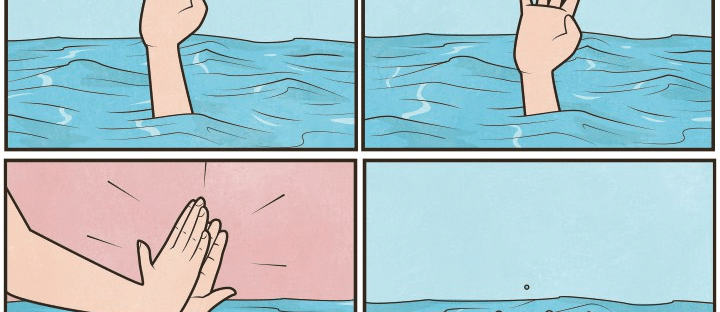
Asking for help from a person without energy limitations can feel like asking to be rescued when drowning, hands tied together and feet tied to a concrete slab. But rather than jump in and get you, the person offers tips and suggestions on how to swim.
This may seem harsh but it’s often the outcome of someone who wants to “help”. And it’s not like I haven’t been this person; it’s deeply programmed into all of us. Fix, alleviate, resolve, make it go away.
Learning how to “swim” is not the issue for people with M.E. We know how to swim, that is, we know how to help ourselves. We have skills, knowlege, talent, resilience, ideas, creativity. The M.E. community is bursting with talent from every area of life you could call work, let alone the potential of those who have been blocked from progressing to a career by this disease. We have thousands of years of collective experience. And I am sure that if we were all to recover completely overnight, it would be such a rocket boost to the world that we might suddenly find ourselves orbiting the suns of Alpha Centauri. (And considering the community includes actual rocket scientists, who knows what is possible.)
Yes, I am being hyperbolic for effect but the point remains. Lack of will and skill is not and never been our problem.
I was always a go-getter (sorry for that awful term). I went, I got, I got bored or disillusioned, so I went and got again. With this latest progression of M.E. for me, there is no longer going or getting, or there might be for a short while. Then I experience a post-exertional crash or a new infection from the brief moment I managed to be out in the world, and a great big wall comes thundering down, crushing both me and any ideas of getting or going. There is now only stopping. Stop. Still. Silent.
It amazes me that our community is able to achieve anything at all with such constriction. And we have. People have fought for bad science to be scrutinised and debunked, for financial support, for research, for recogntion, for better treatment. Some have even diagnosed and treated themselves. Pretty much everyone in this fight has M.E. and has limited physical and cognitive ability in some way. But so much does not get done because we have to do it ourselves. We have had to stop projects, cancel meetings, reduce working hours, give up work, stop planning, stop talking, stop tweeting, stop thinking, stop everything, because our symptoms have gotten worse. So no, it is not lack of will or skill.
It amazes me too, with my HR hat on for a moment, that our main charities and support organisations seem to think functioning like this is all we can hope to expect. Nearly every single person I have engaged with who is advocating for people with M.E. and Long Covid lives with either M.E. and/or Long Covid. All of us are stuck in the sea, in various stages of restriction and constriction, all trying in our own way to rescue each other. If that paints a comical picture it’s likely that it is – an absurdly tragicomical picture. Getting the funding for research, countering misinformation, preventing further illness, finding treatments, building a supportive community, providing the necessary level of care – it does not and will not work alone. Also, unless the whole of our society upends itself from this utilitarian capitalist nightmare, all our advocacy organisations still have to operate in a world of deadlines, competition for funding, last minute requests, multi-tasking and expecting too much from too little. None of these are possible for long, if at all, for people with M.E, so how can ever be possible to run an organisation staffed this way?
Yes, it offers people a chance to be involved, to keep working and those of us affected are best placed to know what we need. But at what cost? I know someone who works for one of our charities who I can tell has too much work piled onto them and when they crash all that work is still waiting when they return. It’s not surprising. It’s how every organisation I have worked for, public or private, large or small operates and a way of working that many of you will be familiar with.
So the harsh reality is that we need people to work with us who do not have limits on their energy. Limits on time is another matter and I wouldn’t suggest asking anyone already time-poor to help, but if people do have an hour here or a half day there, or even minutes at a time, it could make all the difference.
It is strange to be suggesting this as I appear to be advocating for our community to discriminate against itself, by excluding those with energy limitations. But I do not mean replace existing people with M.E, I mean work alongside them. Assist, advocate on their behalf, deputise, let them delegate, learn what they need, be a scaffold of support. In other words, and back to my analogy, take off their bindings, untie and remove the concrete slab, support their arms and help them swim.
I have started to look into how this could happen. There are timebank arrangements where people pledge a set unit of time to do a certain task, usually with a view to some kind of reciprocal offer. There are volunteer organisations usually open to charities, social enterprises and CICs, but sadly not individuals, and there are more formal means such as apprenticeships, internships and paid employment. Of course, the irony is this is as far as I can go, because my arms are still tied and whilst I might not be drowning, I am not far away from it: treading water. You could say, there is no lack of will, nor skill, I’m just too ill to keep this going. It’s pithy little mantra and if the analogy doesn’t work, this might just stick instead.
But I will do what I can, when I can, and highlight what help could really be the most helpful. I hope if you are someone who does not live with such energy limitations you can read this and see what you yourself could do, how you could get involved, what support you could offer. Or if not, just ask.
Because, every day, more of us are thrown into this sea, and too many of us are sinking.
 Writing and M.E.